
Fields in McCracken County Property Tax Records
One annual cycle, two stages. The PVA maintains property characteristics and fair cash value on the assessment side, while the Sheriff issues the current bill and takes payment. Delinquent bills move to the County Clerk after the statutory transfer date.
| Field | What It Shows | Where |
|---|---|---|
| Land and improvement value | The PVA's value components for the parcel | McCracken County PVA |
| Fair cash value | Kentucky's 100 percent assessment standard | PVA assessment roll |
| Exemptions | Qualified reductions applied to taxable value | PVA |
| Bill and payment status | Current charge, discount, penalty, and payment | McCracken County Sheriff |
| Certificate of delinquency | A transferred unpaid bill that becomes a lien | McCracken County Clerk |
Assessed value is not what a buyer paid, and a bill is not a live title record. The date and the custodian behind each number tell you what it can actually support.
The PVA Assesses and the Sheriff Collects
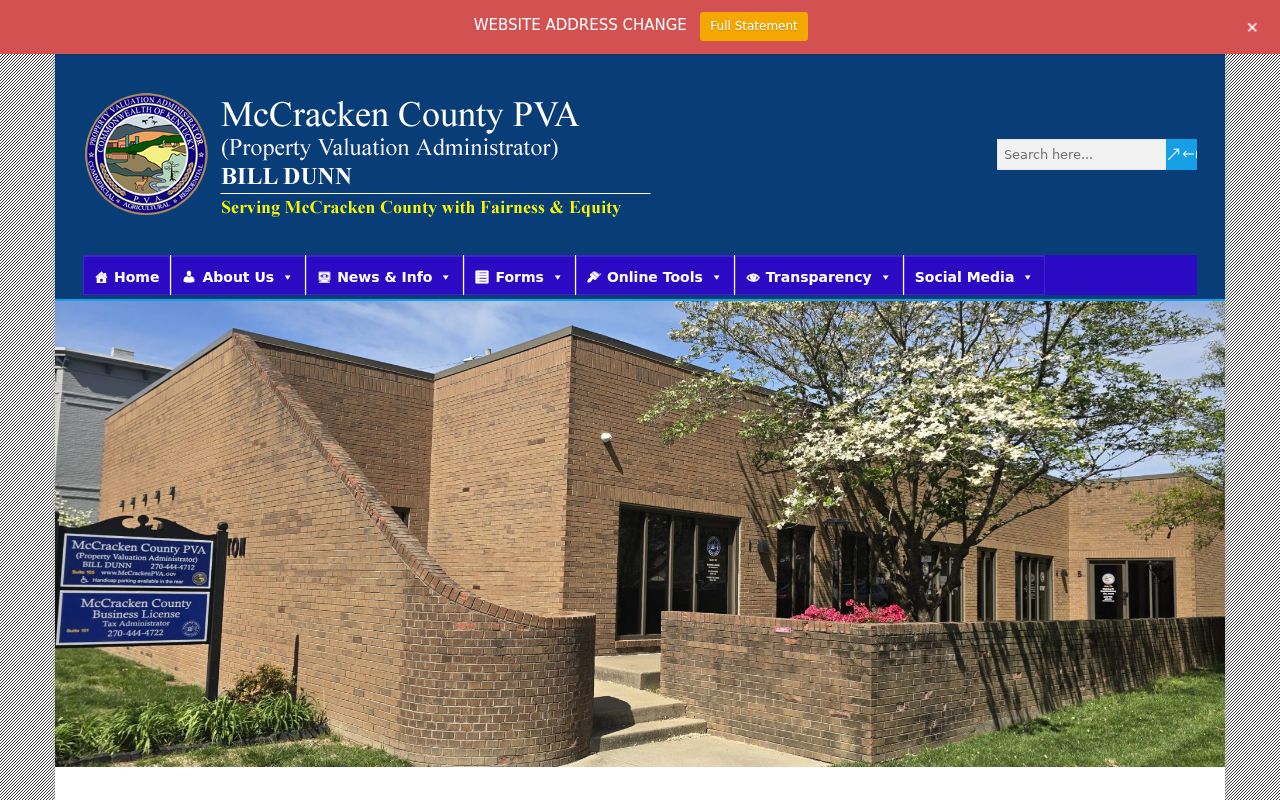
The McCracken County PVA sets fair cash value and keeps parcel facts, sales data, assessment history, tax maps, and aerial links, but it does not bill or collect. Current payments go through the McCracken County Sheriff's tax office. The official PVA page links its assessment, exemption, tax-map, sales, and property-record tools from one landing spot.
Read the PVA record for value and exemptions. Read the Sheriff record for the billed amount, the due stage, and whether it was paid.
January 1 Controls the McCracken Tax-Roll Name
Kentucky assesses real property on January 1. That single date explains a common puzzle in McCracken County property tax records. A seller may have closed the sale in June. The seller can still show as the owner on that year's bill. The buyer may appear only as an "in care of" addressee. A later roll catches up once the transfer works through the system.
Read the owner line as an annual snapshot. Ownership may have changed after a closing. Confirm it against the newest recorded deed in the deed records. For tax responsibility and the billed assessment, always keep the tax year attached. Attach the year to any figure you note.
Note: A tax-bill owner name reflects the annual roll. It is not proof of current title after a later transfer.
Look Up a McCracken County Tax Bill
Start with the parcel identifier in QPublic. A parcel number beats an owner name for precision. Then pull the bill from the Sheriff's current-tax source and read the bill year before trusting any status.
- Search the PVA/QPublic record by address, owner, or parcel and copy the parcel number.
- Use the Sheriff tax source to locate the bill and confirm its year, total, discount or penalty stage, and payment status.
- Return to the PVA card to see the assessment and any exemption reflected in taxable value.
- For an unpaid bill past April 15, check the County Clerk's certificate-of-delinquency records.
- Fair cash value
- Kentucky's estimate of the price property would bring in a voluntary sale.
- Tax rate or levy
- The rate applied by a taxing district to the taxable assessment.
- Homestead exemption
- A qualified reduction for an eligible owner occupying the home.
- Tax lien
- A legal claim arising from unpaid property tax.
Discounts, Penalties, and the April 15 Transfer
The Sheriff's collection cycle runs in steps. Pay in November and get a 2 percent discount. December costs the face amount. January adds a 5 percent penalty, and from February through April 15 the penalty is 21 percent. The Sheriff's page also states that most bills from the 2024 cycle forward carry a $46.26 911 fee. The discount does not touch it.
After April 15, unpaid real-estate bills transfer to the McCracken County Clerk as certificates of delinquency. They become liens. From that point on, ask the Clerk for the current payoff and status instead of an older Sheriff display. Annual charges can change, so confirm the 911 fee for the bill year in question.
McCracken Homestead and Disability Relief
The PVA administers Kentucky's homestead exemption locally. The state lists a $49,100 exemption amount for 2025 and 2026. Eligibility turns on statutory age or disability criteria plus ownership and occupancy of the home.
An exemption lowers the value subject to tax. It does not rewrite the deed or change the PVA's fair cash value conclusion. Apply through the PVA with whatever proof the office requests, then check that the parcel card and bill show the same assessment year.
Kentucky's Four-Year Inspection Cycle
Kentucky requires real property to be physically examined at least once every four years. The PVA may also use sales comparison, cost, income, or agricultural methods where each fits. State law calls for assessment at 100 percent of fair cash value under KRS 132.191.
Land and improvements can move for different reasons. New construction, demolition, a sale, a neighborhood sales pattern, or corrected parcel facts may affect the roll. A tax record should be compared with the PVA's sales and assessment history rather than with one nearby asking price.
Read Land, Improvements, and Sales Separately
The PVA parcel card splits land value from improvement value, and it sets both beside sales and assessment history. That split shows why a total changed. A new structure lifts improvements. A broad market shift can move the estimate of land and buildings through comparable sales.
The PVA's materials also point to photographs, building characteristics, permit-history clues, parcel size, and boundaries. They cover purchase timing, amount paid, and prior-owner information too. Use these fields to test whether the assessed record describes the right property. The assessment is not a private appraisal. Nor is the sale field proof of current market value.
Before a transaction, compare the deed's consideration statement with the PVA sale clue. Not every transfer is an ordinary arm's-length sale. The deed type and parties matter. For tax work, return to the assessment year and the January 1 condition.
Inspect the McCracken Roll in May
May is the month to check the roll. Kentucky's property-tax calendar sets the window. McCracken County opens the real-property roll for inspection for 13 days, beginning the first Monday in May.
A disputed value starts with a PVA conference. Bring proof tied to the January 1 condition of the property, such as recent arm's-length sales, photographs, or a correct property description. The wrong improvement on the PVA card also counts. The argument rests on assessment evidence, not on unhappiness with the tax rate.
District Rates Build the Final McCracken Bill
Fair cash value from the PVA is only one part of the bill. Taxing districts layer their levies on taxable value. Two McCracken parcels with similar assessments can still produce different totals when district coverage differs. The Sheriff bill shows the actual charge. Kentucky Department of Revenue rate books add rate context.
Read a bill from the top. Note the gross assessment, the exemption credited for that year, then the taxable value and district lines. Never apply a rate from another year or place. City limits, school districts, and special charges all matter. Confirm jurisdiction instead of trusting a postal city name.
Most bills since 2024 carry a $46.26 911 fee. That charge sits outside the two percent discount, per the Sheriff's page. It can change each cycle. Verify it on the current bill before quoting a payoff. A receipt proves a payment arrived; it settles nothing about ownership or boundaries.
Delinquent Certificates Become McCracken Liens
Real-estate bills unpaid after April 15 transfer to the County Clerk as certificates of delinquency. Each certificate is a lien. Use the Clerk's current record for payoffs.
Check the taxpayer name, parcel identifier, tax year, transfer date, and any later assignment or satisfaction. Names alone can mislead. One owner may hold several parcels. The parcel number and legal description keep the lien tied to the right tract.
Kentucky law lets a certificate be sold through a statutory process, so the record can change after the Sheriff bill leaves current collection. A stale bill image cannot show the present balance. Before a purchase or estate closing, compare the tax lien search against deed and mortgage indexes in McCracken County.
Appeal a McCracken County Assessment on Time
The PVA conference is not the last word. Next comes the county board of assessment appeals. Kentucky's calendar requires filing no later than one workday after the inspection period ends. The board meets for 25 to 35 days as needed, and further review follows the state process.
Protect the deadline. Complete the PVA conference during the May inspection period and file with the county board by the next working day after that period closes.
Keep each record separate. Save the dated assessment card, bill, payment record, and any delinquency reference as distinct items. Their dates and custodians explain apparent conflicts.