
Trace McCracken County Former Owners by Era
Start at the McCracken County Clerk Records Vault. The Clerk holds the deed records. eCCLIX adds online coverage, though the county publishes no earliest year for it, so older research moves to books, microfilm, and library holdings rather than assuming every transfer appears online.
| Source | Years It Covers | Where Held | What It Shows |
|---|---|---|---|
| eCCLIX deed index | Current online span; earliest year not posted | Clerk portal | Parties, date, type, book and page |
| Deed microfilm | 1825-1995 | KDLA and local research access | Earlier conveyances and deed-book images |
| Historic plats | Record-specific | Clerk, planning, archives | Subdivision, lot, block, and dedications |
| Tax-assessment film | Runs from 1824-2007 with gaps | KDLA | Year-by-year assessment clues |
Start online for recent former owners. Use each deed reference to bridge into the right book or roll. Tax entries help build a timeline. They do not replace conveyances. Record the year, source, and exact name form for every link so later conflicts can be checked.
These sources overlap rather than merge into one database. A recent index entry may point to a twentieth-century deed book, while a tax roll or city directory supplies the spelling and date needed to reach an older McCracken County former owner.
eCCLIX Begins the McCracken Former-Owner Chain
eCCLIX searches run by book, page, and party. Document type and date filters also work. McCracken County residents get five free searches a day; broader commercial use requires a subscription. The county publishes no first online year for the portal, so treat eCCLIX as a convenience rather than the beginning of a property's history. The McCracken County Clerk Records Vault identifies the county's official recorded-document route.
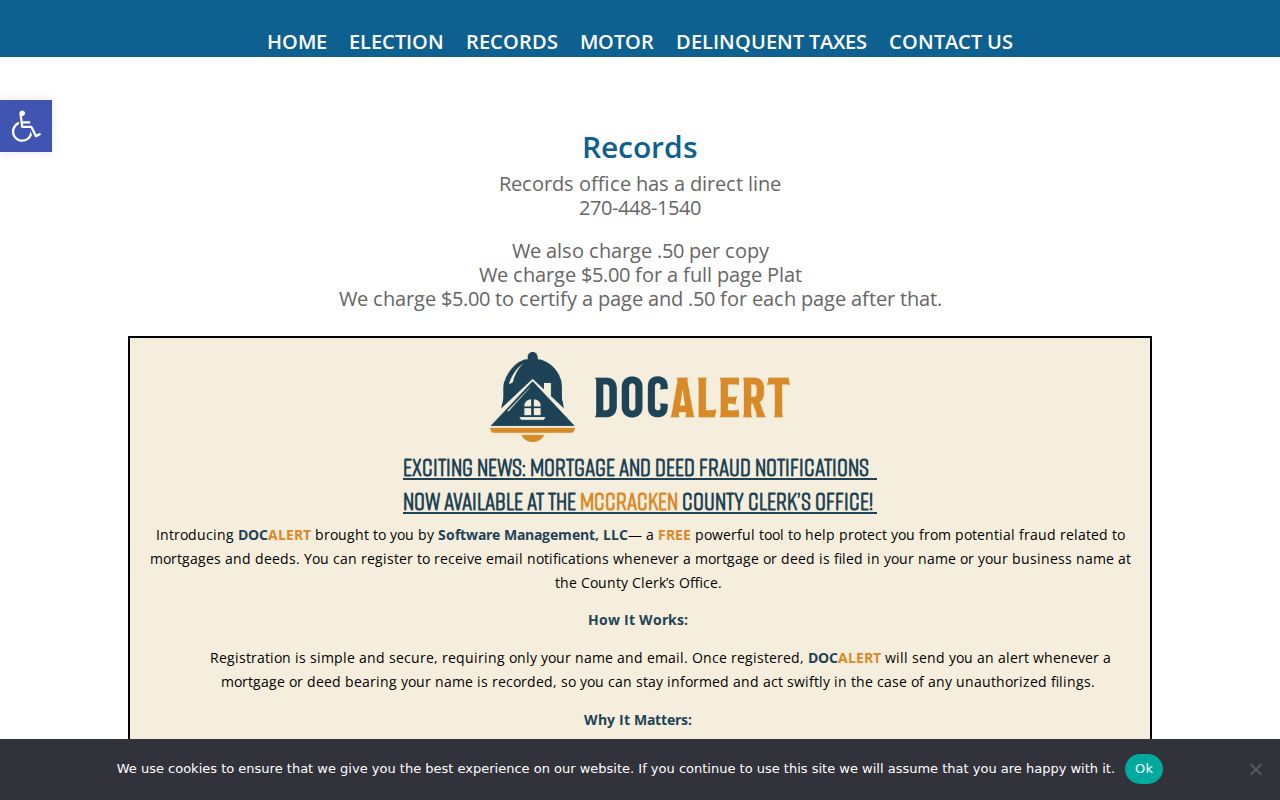
The Clerk's records page anchors the online search. eCCLIX supplies indexed parties and deed references. Together they tie the portal back to the county custodian of the deed records. Search the present grantee and open the newest deed. Preserve its source-of-title, legal description, book, and page. If nothing likely appears, vary initials, surnames, entities, and dates before moving offline. One missed spelling can hide a prior owner even when the deed exists.
Walk the McCracken County Deed Chain Backward
Each chain row records one transfer. Keep a working timeline. Columns for transfer date, grantor to grantee, deed type, and book and page make any skipped link visible at a glance.
- Find the current owner's acquiring deed with that owner as grantee.
- Read the grantor, source of title, legal description, and deed reference.
- Search that grantor as an earlier grantee and repeat the match.
- When online results end, continue with the cited deed book and microfilm.
| Transfer date | Grantor to grantee | Deed type | Book and page |
|---|---|---|---|
| Newest transfer | Seller to current grantee | Copy exact instrument label | Record the cited reference |
| Prior transfer | Earlier seller to later grantor | Copy exact instrument label | Follow the earlier citation |
| Older link | Repeat through prior owners | Note unusual conveyance | Move to deed book or film |
- Grantor
- The party conveying an interest.
- Grantee
- The party receiving that interest.
- Chain of title
- The ordered sequence of linked conveyances.
- Reverse index
- An index used to locate a prior grantee before that person conveyed onward.
- Quitclaim and warranty deeds
- Different forms of conveyance that should not be treated as equal promises about title.
Never skip a link just because a surname repeats. A parent, child, spouse, trustee, or business may hold a different interest entirely. Each step must concern the same legal tract.
McCracken Former Owners on 1825-1995 Microfilm
McCracken deed microfilm runs from 1825 through 1995. The KDLA land inventory documents that span. Use the Kentucky microfilm guide to find a roll. Search by location, record type, court, and date. The County Clerk vault and McCracken County Public Library offer other local routes.
The online cutoff is unposted. A failed web search proves nothing about an older deed. Carry the cited book and page into the offline request. Save both references when the index and image sit on separate rolls.
Offline handoff. When eCCLIX stops, continue in the 1825-1995 deed microfilm and cited deed books.
The Library Tests McCracken County Prior Owners
The McCracken County Public Library genealogy collection holds deeds, marriages, and wills from 1825, plus selected court and tax microfilm. Paducah city directories run from 1859 forward. Newspapers and vital indexes round it out.
A directory can place a name at an address in a given year, and a will or tax roll may explain why that name appears between recorded sales. These clues matter most when an old address changed or a family transfer left no ordinary sale. They point to the next deed book. They do not prove title by themselves.
Probate Can Break a McCracken Prior-Owner Sequence
Death moves property interests through channels beside sale deeds. A will, probate order, survivorship clause, life estate, or affidavit of descent can transfer the interest. When the expected grantor-to-grantee link is missing, search wills and probate records.
Heir, executor, trustee, and fee owner name different roles. Record each one exactly. Then match the instrument to the same legal tract. The probate file explains authority to convey, and the later deed returns the chain to the land-record series.
McCracken County's Early Dates Need Caution
Local narratives place McCracken County's formation in 1825. One KDLA chart shows 1821. That conflict warns against forcing a record into an assumed year or claiming former owners can be traced farther than the cited collection allows.
For early deeds, cite the exact archive inventory, volume, and image used. Verify the jurisdiction and creation date with the custodian rather than silently picking one. The documented deed-film run begins in 1825. That year is the defensible local benchmark.
Plats Keep McCracken County's Same Land in View
A deed chain can look like it ends when acreage becomes lots or a subdivision renames the land with a new lot-and-block description. Recorded plats bridge those forms. They are among the County Clerk's advertised record categories.
Compare subdivision name, lot, block, adjoining calls, and source-of-title language. The plat explains the geometry and naming change. The deeds still supply the actual sequence of previous McCracken County owners. A neighborhood map name is not the legal subdivision.
Tax Rolls Check Gaps Between McCracken Deeds
The KDLA tax-assessment film covers 1824 through 2007, though the run has gaps. Those missing years matter. A continuous string of tax entries can show a name staying tied to the same land between sales, or it can point to the stretch where an ownership change probably happened. Treat the tax roll as supporting evidence, never as a conveyance. It narrows the year and the spelling. Then the real proof comes from the grantor-grantee index, the deed book, a probate file, or the plat. Note every missing year in the collection. Silence in a tax roll is not evidence that no transfer occurred.
How Far Back McCracken County Ownership Goes
Deed research in McCracken County reaches back to 1825 through the microfilm run. The earliest year in eCCLIX remains unclear. Even so, a chain of ownership can stall for many reasons. A tract split, a changed legal description, a name variation, or a probate event can each break the sequence. A missing index entry can too. Plats and tax books help reconnect the tract. Neither one replaces the transfer document itself. Report your stopping point honestly. The last solid link may be a specific deed book, roll, or probate file. Cite it plainly. Describe what remains unproved. Do not tack an unsupported name onto the list of former owners.
Lawful use. Former-owner research supports house history, estate work, and property diligence. Never use it to track, harass, or harm a living person.