
The McCracken County Owner-of-Record Card
The McCracken County PVA links to QPublic for property records, tax maps, and aerial imagery. The parcel card gives the present tax roll entry plus the identifiers needed to confirm the owner of record elsewhere.
| Owner name | The person or entity named on the roll |
|---|---|
| Mailing address | Where owner notices are directed |
| Situs | The physical property address |
| Last sale | A timing and price clue, not title proof |
| Deed reference | A pointer to the recorded transfer |
An owner of record is not always an occupant. Owner mail may go to another state. An LLC, trust, estate, life estate, or survivorship interest can also leave a short name line incomplete. Attach the parcel number to every note. It is far more stable than a spelling or postal label.
Treat the card as a present-roll snapshot rather than a title opinion. A careful property search preserves the displayed tax year, sale date, and deed reference. Each statement carries its own date.
Parcel cards also list the map number, legal description, subdivision, and lot and block. Structure facts, photographs, permits, and aerial or GIS map links may appear as well. These fields are identity checks. Two parcels can share a similar street label. Their parcel numbers and legal descriptions should never be casually swapped.
How Current Is the McCracken County Owner Record?
Kentucky puts a hard line in the sand each year. Assessment follows ownership on January 1. Sell a McCracken County parcel in March, and the tax bill still carries the January 1 owner of record. The buyer may show up only as an "in care of" addressee on the same notice. That single calendar date explains most mismatches between the PVA name and a deed. The deed may be freshly signed. No fixed lag governs how quickly McCracken County property records catch up. The practical move is to note when you searched. Then weigh the newest deed's recording date against the year printed on the parcel card.
Recent-sale check. No average local update lag is published. The newest recorded deed is the more current source after closing.
PVA Research Adds Current-Owner Clues
According to the PVA property-research page, parcel research can reveal owner and mailing details, purchase time and price, prior owner, acreage, structures, photos, permits, and survivorship clues.
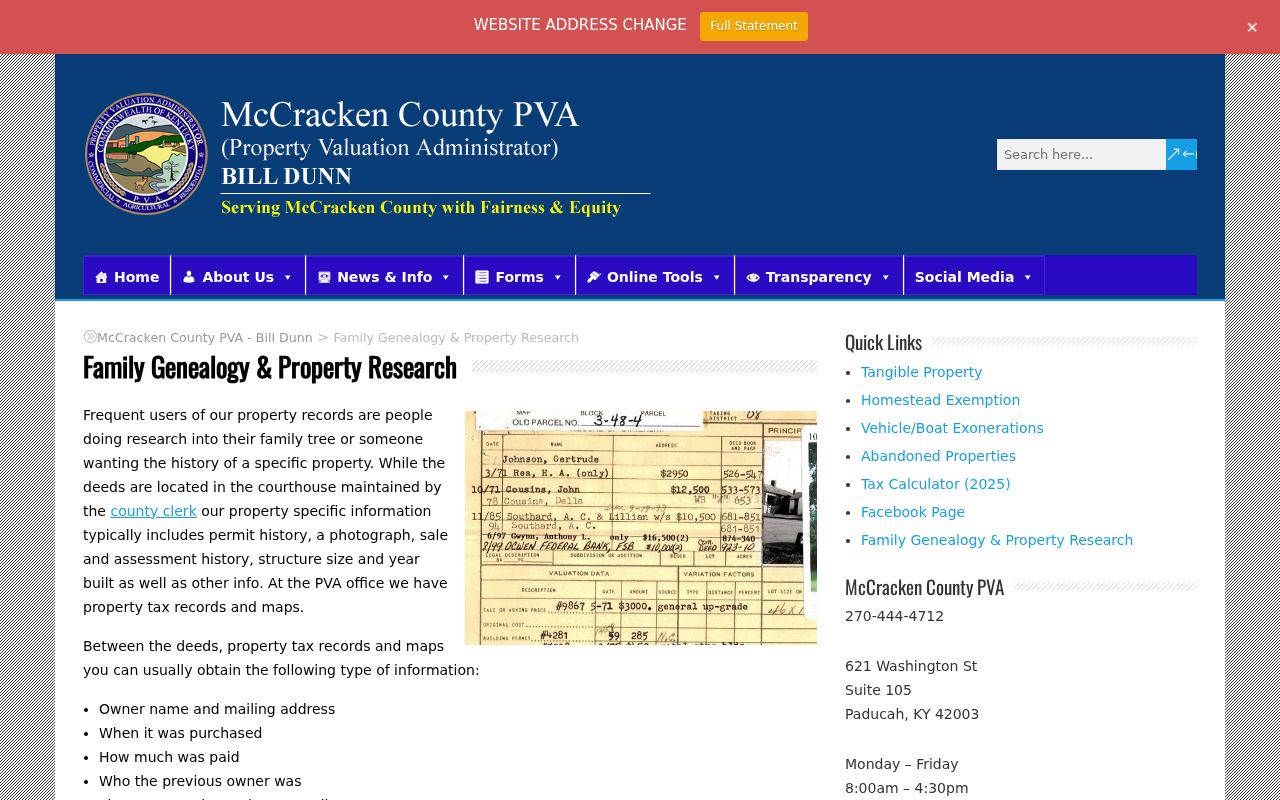
The page shows how the owner card fits alongside deed, map, sale, and structure evidence. A photograph or structure description helps rule out the wrong parcel. Neither one identifies the owner of record without the name and deed fields.
Purchase price and prior-owner fields hint at the last transfer. They should prompt a check of the cited instrument. That check matters when the owner name is abbreviated, an estate is involved, or multiple grantees took title.
Confirm the Current McCracken County Owner
Lead with the parcel card, then confirm through the Clerk Records Vault and eCCLIX.
- Match the QPublic card to the situs and parcel number.
- Copy the owner, mailing, sale, and deed-reference clues.
- Find the newest recorded deed and compare its grantee and legal description.
- Verify a named company in Kentucky's business entity search.
- Owner of record
- The party named on the official record.
- Vesting
- The way title is held as stated in a deed.
- Assessment roll
- The annual parcel and value list.
- Situs
- The physical location, distinct from mailing.
- Registered agent
- An entity's official recipient for legal notices, not automatically the landowner.
- Recording lag
- The interval among closing, recording, and display updates.
Agreement among the parcel number, legal description, grantee, and deed reference beats a street-address match. That agreement wins every time. If those keys conflict, ask the PVA or the Clerk to explain the record. Don't guess which field is right.
Keep a short source log listing the portal, search date, tax year, instrument date, and recording date. That log separates a current display from the legal event behind it. It also gives the custodian enough detail to answer a question. No one has to repeat the whole property search.
McCracken County Current Owners Held by an Entity
Copy a company name exactly into the Kentucky Business Entity Search. The tool helps distinguish entities but does not replace the deed. Its profile may confirm an exact legal name and status. Yet a registered agent is not automatically the parcel's current owner.
Trusts may list trustees. Estates can involve wills, probate orders, affidavits of descent, or survivorship terms. Present ownership can hold partial or life-estate interests a brief owner card never explains. Read the vesting clause and every grantee name on the newest deed. Do this before reducing the record to one person.
DocAlert Watches McCracken County Owner Names
The Clerk offers free DocAlert notices for deeds and mortgages filed under a registered name. Once the official name form is known, it makes a useful local follow-up. It can also flag unexpected filing activity.
An alert blocks nothing. It does not decide validity or prove an instrument affects the right parcel. Inspect the document through the Records Vault. Compare its legal description with the owner-of-record card.
Mailing and Situs Fields in McCracken County
Situs and mailing address are separate fields on McCracken County parcel cards. Situs marks the land's physical location, while the mailing field receives assessment notices. An out-of-county mailing address therefore proves nothing about ownership.
By the same logic, a person receiving mail at the situs is not shown to be the current property owner. Use the public mailing address only for a legitimate property matter, and pair it with the parcel number so a similar street address never points to the wrong record.
When McCracken County Fields Do Not Match
A mismatch is a prompt, not a dead end. Compare dates and record types first. The PVA roll shows who is listed for assessment, the deed names the grantee in a conveyance, and the tax record follows the annual billing cycle, so each source can be accurate for a different moment. That is normal. Misspellings, initials, changed entity names, multiple owners, and “care of” lines also affect a name search. Try reasonable variants. Report the exact spelling shown on each source, and never merge two people or entities merely because their names look alike.
Deeds raise a separate trap. A deed may convey only part of a tract. It may also transfer just one party's interest, so read the legal description and vesting language rather than the first grantee line. When a life estate, survivorship term, or partial interest appears, preserve that qualification when describing the current property owner.
Reach a McCracken County Owner Lawfully
Use the public mailing field for any property matter. It is the proper record-based contact route. Kentucky Safe at Home may supply a substitute mailing address, though its official guidance says real-estate holdings are not hidden. Respect that address as displayed. Treat it as a substitute, never as an invitation to hunt for a private location elsewhere.
Verify before you act. For a purchase, boundary question, estate matter, or suspected filing, confirm the current owner of record with the custodian first. Public access does not guarantee that a copied name is current, complete, or suitable for personal contact. The Kentucky Open Records Act backs record access. Access still is not permission to misuse personal data. Keep the inquiry tied to the parcel and the lawful property issue, and let the official record speak only for the date and purpose it covers.
Lawful use. Use owner information for legitimate property questions, never to stalk, harass, intimidate, or harm anyone.